

How to Play a Jeopardy-Style Game in Class: Rules, Teams, Scoring and Timing
Split the class into 3–5 teams of 4–6, project a 5×5 board, and rotate which team picks. The picking team gets about 20 seconds to confer and answer through one spokesperson; a wrong answer opens a…
Key takeaways
- 01Rotate picking by team order, not by who answered last — it keeps quieter teams in the game.
- 02One spokesperson per team per clue, rotating, stops the same student answering every time.
- 03A single steal in fixed order is easier to referee than a free-for-all buzz.
- 04Skip negative scoring in review games; it discourages attempts without improving recall.
- 05Plan for 15–20 clues in 25 minutes; roughly a minute per clue including discussion.
This is a run sheet, not a roundup. It assumes one projector or screen, one host, and no student devices. The rules work with any board — a browser tool or a grid on the whiteboard. For choosing the tool itself, see Classroom Review Games That Don't Require Student Devices or our broader Jeopardy-style classroom tools guide.
The timings below are planning guidance, not measured results — adjust after your first round.
Before class: setup checklist
- Board: 5 categories × 5 clues (100–500). Put one easy recall clue at 100 in each column so teams can score early.
- Answer key: keep it on paper or a second window, not on the projected screen.
- Timer: a phone stopwatch or a browser timer you can see; students do not need one.
- Scoreboard: in the tool, or a corner of the whiteboard.
- Teams: 3–5 teams of 4–6, pre-assigned to save time. Mix confident and quieter students.
- Spokesperson order: each team numbers its members 1–6; spokesperson rotates by number every clue.
The rules (read these aloud)
- Turn order. Team 1 picks first, then Team 2, and so on, regardless of results. Write the order on the board.
- Pick and reveal. The picking team names a category and value; the host reveals the clue.
- Confer, then answer. The team has 20 seconds to discuss. Only the current spokesperson answers.
- Correct: award the tile's value. Mark the tile as played.
- Wrong or timeout: the next team in order gets one steal, with 10 seconds. Correct steals earn the full value. If the steal fails, the host reads the answer and moves on.
- Calling out: a team that answers out of turn passes on that clue.
- No deductions on the picking team. Optional: deduct on failed steals for older students.
- Host is final judge. Decide in advance whether spelling counts and whether "what is…" phrasing is required (we suggest not).
Scoring
Keep scoring simple and visible. Update the projected score immediately after every clue so disputes surface while the clue is fresh. One way to run this is with Kleveroo's free manual board: the teacher projects the board and controls the clues, timer and team scores while students answer aloud. Only the host needs a device. You can also use a different board maker or draw the grid on a whiteboard; these rules are the same.
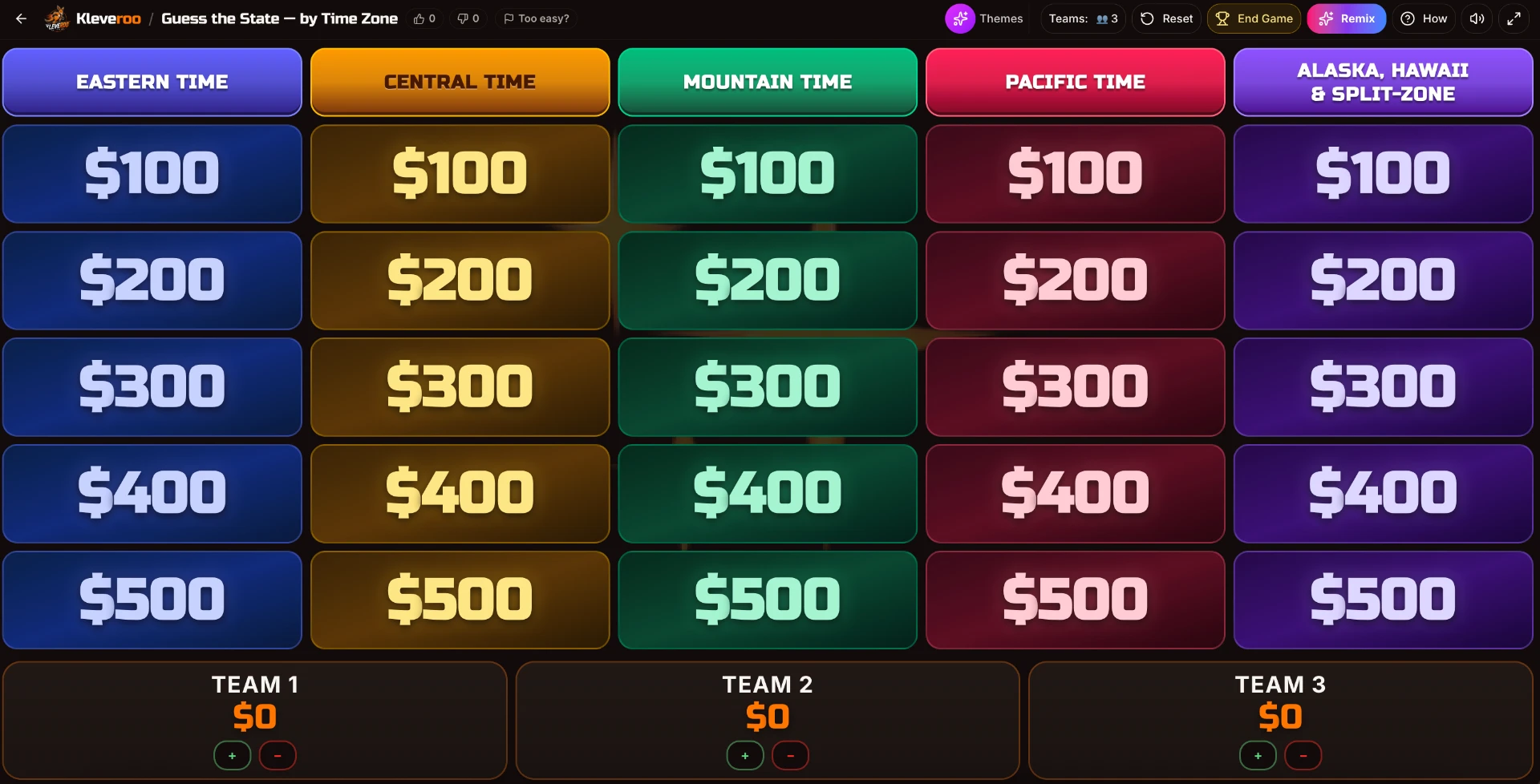
Kleveroo board shown as a one-screen example. Brain Rush Games and Kleveroo share an owner; see our editorial disclosure above.
Timing
| Phase | Time |
|---|---|
| Explain rules, assign teams | 3 min |
| Main board, ~15–18 clues | 17 min |
| Final question with wagers | 3 min |
| Tie-break / wrap-up | 2 min |
| Total | 25 min |
At about a minute per clue including discussion, you will not finish a 25-clue board in 25 minutes — and you should not try. Stop with five minutes left and go to the final question. For a 30-minute slot, add five more clues.
Ties
Use one sudden-death question read aloud. Each tied team writes its answer on paper; the first correct answer revealed wins. If still tied, both teams share the win — rarely worth a second tie-breaker in a review lesson.
Worked example
Three teams: Red, Blue, Green.
- Clue 1 — Red picks Fractions for 200. Red's spokesperson answers correctly: Red 200.
- Clue 2 — Blue picks Vocabulary for 300, answers wrong. Green steals correctly: Green 300.
- Clue 3 — Green picks Fractions for 100, times out. Red's steal is wrong. Host reads the answer; no change.
- Clue 4 — Red picks Map Skills for 400, correct: Red 600.
Score after four clues: Red 600, Green 300, Blue 0. Blue still picks next, which is the point of fixed rotation — the trailing team keeps getting chances.
Final question: Red wagers 400, Green 300, Blue 0. Red and Green answer correctly: Red 1,000, Green 600, Blue 0.
Common pitfalls
- Big-value clues that are only harder trivia. Make 400–500 clues ask students to explain, apply or compare, not recall a more obscure fact.
- The same student always answering. Rotating spokespeople fixes it.
- Steal chaos. One ordered steal, never an open shout.
- Running out of time. Cap the board, not the final round.
- Answer key on the projector. Keep it off the shared screen.
- Ignoring wrong answers. Read the correct answer aloud every time; that is where the review happens.
Related guides
Running something less academic? How to Run a Trivia Night People Actually Enjoy covers rounds and pacing for adult groups, and Best Free Jeopardy-Style Game Makers compares free board builders.
Frequently asked questions
- How many teams work best for classroom Jeopardy?
- Three to five. Fewer means long waits are rare but teams are large; more than five makes each team's turns too infrequent in a 25-minute slot.
- Should wrong answers lose points?
- For review, we recommend no deductions. If you want stakes, apply deductions only to steals, where answering is optional.
- What if a team calls out an answer out of turn?
- Treat it as a pass for that team on the current clue. Announce the rule before play so it does not feel arbitrary.
- Do I need buzzers?
- No. Fixed turn order plus a single ordered steal removes the need to judge who buzzed first.
- How do I handle Final Jeopardy-style wagers?
- Teams write a wager no higher than their score on paper before seeing the clue, then write the answer. Reveal both together.
Sources & verification
- JeopardyLabs — about / how to play and scoring shortcuts (accessed and verified October 16, 2026)
- Factile — features, team and buzzer options (accessed and verified October 16, 2026)
- Baamboozle — homepage, one-screen play (accessed and verified October 16, 2026)
- Kleveroo — teacher and projected board features (accessed and verified October 16, 2026)
We write original factual summaries from official product pages and our own hands-on use. We do not reproduce marketing copy.
- jeopardy in class
- classroom jeopardy rules
- review game rules
- team scoring
- classroom games
Keep reading
More in this section